In the healthcare sector, software interoperability is far more than a simple technical feature. It is the key to enabling more efficient coordination and more comprehensive patient care. In Switzerland, where excellence in healthcare is a priority, this interconnection of information systems has become a critical requirement to ensure optimal patient care.
The challenges of the lack of interoperability
The lack of healthcare software interoperability creates a series of major challenges for Swiss healthcare facilities. Information silos form barriers that prevent smooth communication between departments and healthcare professionals. As a result, medical decisions may be delayed, procedures may be unnecessarily duplicated, and the quality of care can be compromised.
Patients may also experience disruptions in their care journey, with less seamless transitions between services. At the same time, the absence of interoperability complicates administrative management, including billing processes, medication inventory management, and human resource planning. These processes become more prone to errors, which can ultimately impact the financial performance of healthcare facilities.
The benefits of interoperability
Healthcare software interoperability enables instant access to complete patient medical records. This allows healthcare professionals to make well-informed decisions based on accurate and up-to-date information, resulting in faster diagnoses and more effective treatment plans.
Thanks to interoperability, the risk of medical errors is significantly reduced. Medical information is synchronized and updated in real time, preventing inconsistencies or omissions in patient care. Duplicate examinations and tests are also minimized, helping to optimize resources and ensure the efficient use of medical equipment.
ClevEHR, the solution that promotes interoperability
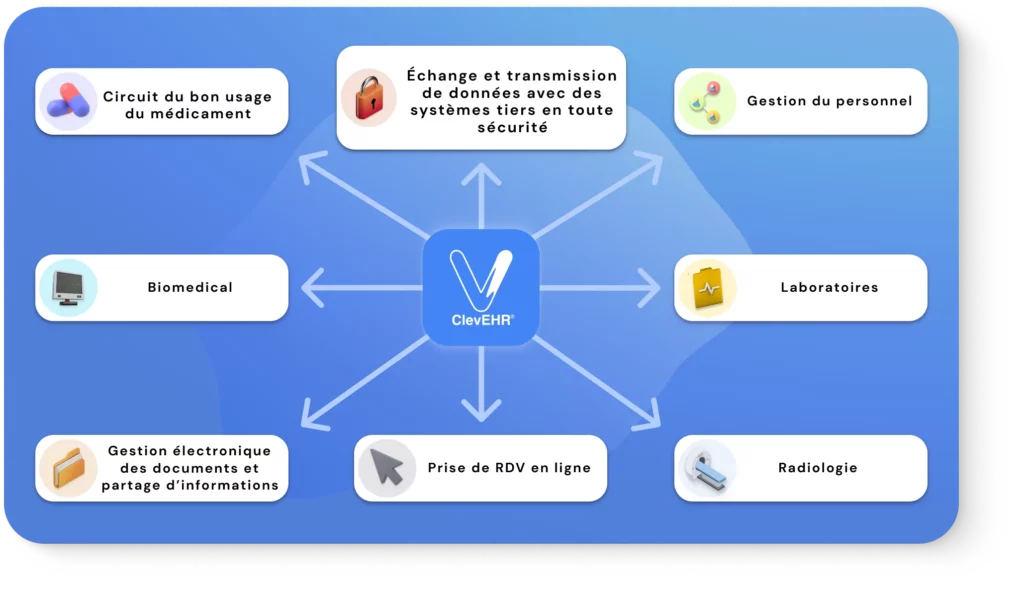
ClevEHR stands out as a healthcare activity management solution that places interoperability at the core of its design. Built to meet the diverse needs of healthcare facilities, it goes far beyond basic electronic patient record management. By centralizing information and facilitating access to it, ClevEHR improves both the efficiency and effectiveness of healthcare organizations, enabling better patient care.
Its key strength lies in its borderless connectivity. ClevEHR features seamless integration with 186 modules, as well as with Imeds and JustLink solutions.
In specialized fields (such as oncology, ophthalmology, and others), interoperability becomes an absolute requirement. The ability to efficiently share information between specialized departments enhances care coordination, reduces delays, and ensures more accurate treatments. ClevEHR is also interoperable with Swiss federal platforms, ensuring maximum compliance with national requirements and fostering effective collaboration among all stakeholders in the healthcare network.
Choosing ClevEHR means opting for healthcare management redefined through interoperability. It is not just a solution, but a trusted partner for seamless connectivity and uncompromising healthcare activity management.
In summary, healthcare software interoperability is essential for optimizing care within healthcare facilities. Without it, communication between services becomes complex, leading to delays and increased risks of medical errors. Conversely, when systems are interoperable, healthcare professionals benefit from fast, secure access to information, strengthening decision-making and ensuring high-quality patient care.