
A Design Thinking approach
While the digitalization of patient records within healthcare institutions is now well established in 2025, it nevertheless requires careful design to meet the expectations of end users as closely as possible. As a software publisher, Kheops Technologies is committed on a daily basis to this development approach known as Design Thinking, or User-Centered Design, whose objective is to place the user at the heart of the process.
The project aimed at improving electronic medical prescribing within our Swiss electronic patient record solution, ClevEHR (code name: PRCV2, for those in the know), perfectly embodies this approach.
Electronic medical prescribing: the challenges of an intuitive interface
A nurse documents a care activity. An anesthesiologist adjusts dosages. A physician prescribes an infusion.
A recurring daily task—regardless of the type of order—medical prescribing is one of those core clinical processes in which users have a very clear intent even before they begin entering the prescription.
When viewed through the lens of electronic prescribing, the challenge lies in delivering an ergonomic, intuitive interface that accurately captures and supports this intent with maximum efficiency.
In this context, the digital tool must follow the user’s thinking—not the other way around. The system adapts to the needs and uniqueness of each situation. The application interface aligns with natural clinical reasoning.
A collaborative innovation
With this vision in mind, ClevEHR electronic prescribing was developed in partnership with many of our clients—major healthcare stakeholders in Switzerland. Specialist physicians, nurses, and EHR managers worked closely with Kheops Technologies analysis teams, including business analysts, developers, medical informatics physicians, and nurses.
Together, they engaged in an ambitious, iterative, and collaborative process aimed at defining a new paradigm for medical prescribing.
The mental model of prescribing
From this collaborative effort, Kheops developed what we call the Mental Model of Prescribing—an interdisciplinary consensus reflecting natural clinical reasoning and the key stages of medical prescribing. From this model, we designed a graphical interface that is clean, adaptive, and as intuitive as possible.
UI & UX driven by user needs
This user-centered approach ensures that electronic prescribing supports clinical workflows seamlessly, enhances efficiency, and delivers an experience aligned with real-world medical practice.
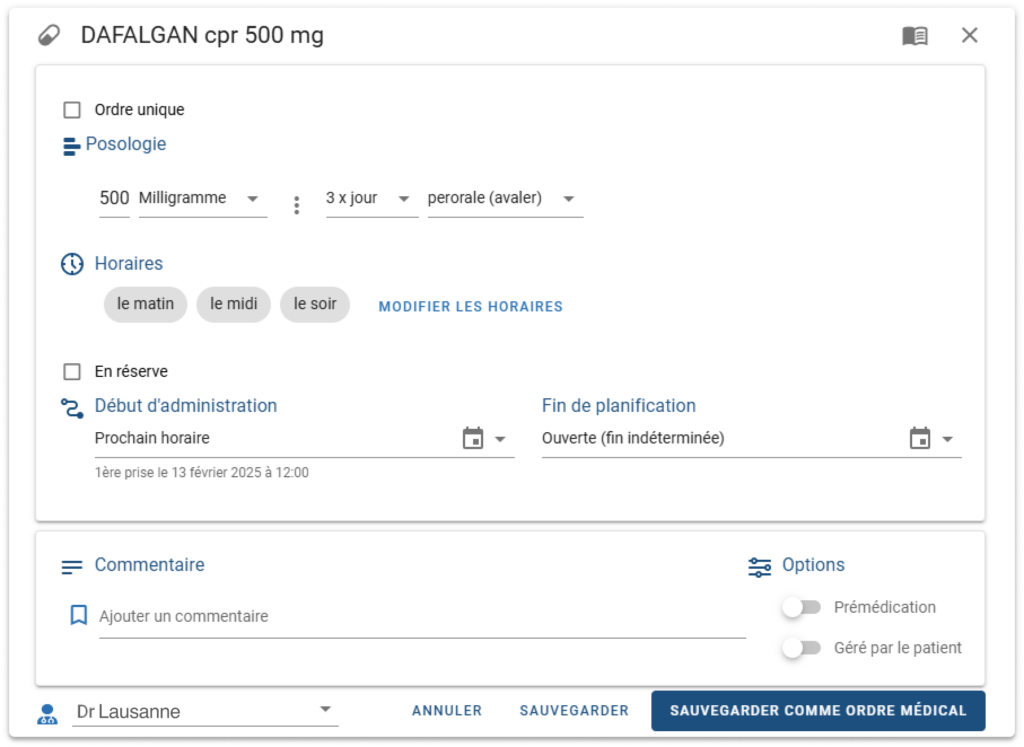
ClevEHR Prescribing
Designed based on the ClevEHR Design System, the user interface is built for efficiency and is structured around several key functional and technical principles, including:
An adaptive and scalable interface
Because prescribing an oral medication (per os) is fundamentally different from prescribing an intravenous analgesic or a care activity, the interface automatically adapts to the different types of products and clinical contexts. It evolves and transforms dynamically as the prescription is being created and as the user makes selections.
The interface absorbs variability, allowing the user to remain focused on their objective without disruption.
The Pareto principle
Depending on the prescribing context, and for each component of the dosage, the interface prioritizes the most frequent use cases according to the Pareto principle (the 80/20 rule). Without excluding less common scenarios, this approach seeks the right balance within a model that offers many possible options.
The interface remains uncluttered, enabling users to focus on what truly matters.
Automated data entry
The system also leverages the prescriber’s prescription history. Combined with preliminary application configuration, it proposes the most comprehensive possible pre-filled dosage suggestions.
While this does not replace medical decision-making—the prescribing physician always remains fully responsible—it significantly reduces manual input, shifting the user’s effort toward adjustment and verification rather than data entry.
The interface is suggestive, enabling efficient and focused use.
Clinical workflows: balancing roles
Beyond medical safety, the new ClevEHR prescribing module complies fully with current Swiss legal requirements related to medical prescribing. It incorporates the real-world complexity and demands of healthcare professions, promotes best practices, and ensures a balanced distribution of responsibilities between physicians, pharmacists, and nurses.
Validating prescriptions through physician signatures and clearly defining the scope of medical orders are key functional mechanisms that ensure regulatory compliance and alignment with institutional policies.
A foundation for future developments
While this first phase aims to build user trust and adoption in the face of the demands imposed by the necessary transformation and digitalization of healthcare professions, it also opens up many перспективes for future developments that lie at the heart of the ClevEHR solution vision.
The Kheops Technologies teams are continuing this line of thinking, with several upcoming developments, including:
- Integration of specific prescribing models, such as:
- Cyclical prescribing
- Protocol-based (schema-driven) prescribing
- “Dependent analyses”
- Integration with clinical care protocols
- An enriched medication catalog, a fundamental prerequisite for:
- INN-based prescribing (International Nonproprietary Name)
- Medication allergy management
- Integrated care plans
- Machine learning and artificial intelligence
- A mobile application, enabling healthcare professionals to manage prescriptions on the go
Written by Simon D.
Business Analyst at Kheops Technologies SA