In a hospital environment where every second counts, Kheops Location System (KLS) stands out as an innovative solution for optimizing patient flows and improving quality of care. Discover how our software enhances healthcare facility management.
Recurring challenges
Healthcare professionals are frequently faced with several challenges that complicate their daily work. The main issues include:
❌ Inefficient patient pathway management, leading to errors or delays in care
❌ Lack of appropriate communication tools between departments, causing misunderstandings and slowing team coordination
❌ Difficulties in analyzing patient pathway efficiency, limiting opportunities for continuous improvement
❌ Administrative overload, due to manual and time-consuming processes, reducing time available for direct patient care
These challenges not only affect the efficiency of care delivery but also impact the well-being of healthcare professionals, who are already under significant pressure.
In response to these challenges, KLS was designed to deliver concrete and effective solutions
Kheops Location System (KLS):
✅ Simplifies information management
✅ Promotes smooth and efficient communication between teams
✅ Provides KPIs to measure patient pathway efficiency
✅ Automates administrative processes
This software helps free up valuable time for healthcare professionals while improving the overall quality of care.
The idea behind this solution is the result of the combined expertise of Kheops Tehttps://www.kheops.ch/en/home/chnologies and the real-world experience of healthcare professionals, with the goal of delivering tangible improvements in healthcare facility management.
What is KLS?
Kheops Location System (KLS) is a patient flow management software designed to optimize the organization of healthcare institutions. It enables real-time patient tracking, management of room occupancy rates, and improved internal and external communication.
Through features such as automatic alerts in case of delays, traceability of patients and/or medical equipment, and detailed reporting, KLS enhances coordination between clinical teams and administrative staff—reducing costs and improving efficiency. In addition, it automatically sends SMS notifications to companions.
How does KLS address these challenges?
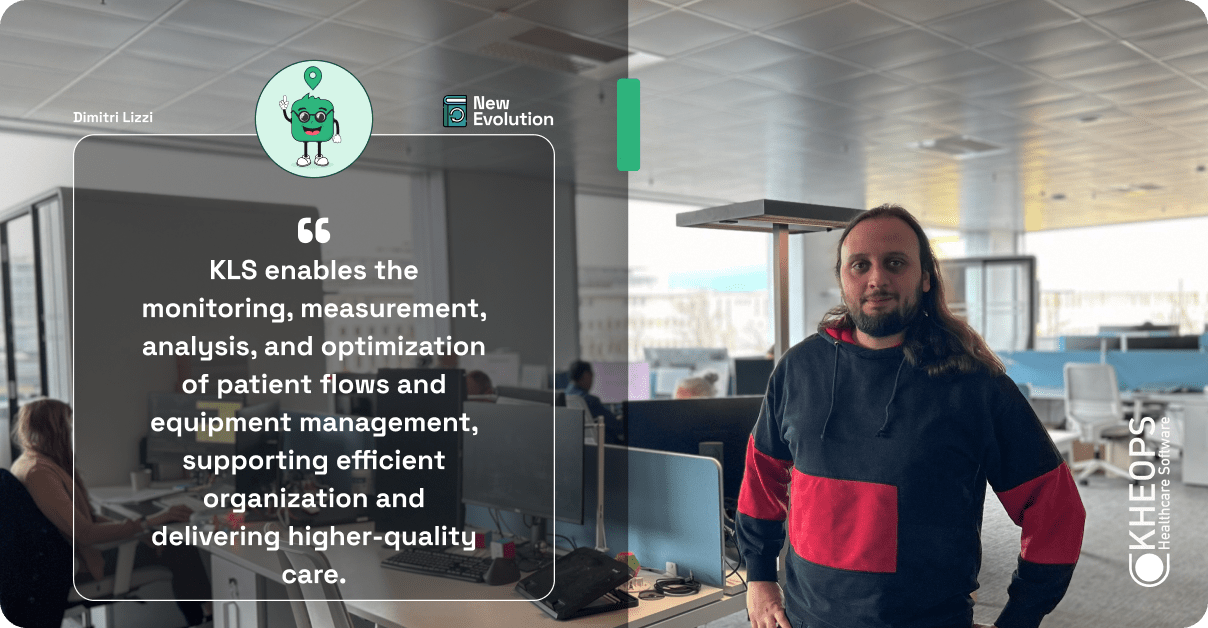
Kheops Location System enables healthcare institutions to monitor, measure, analyze, and optimize key aspects of the hospital patient journey, ensuring efficient management and delivering a higher quality of care.
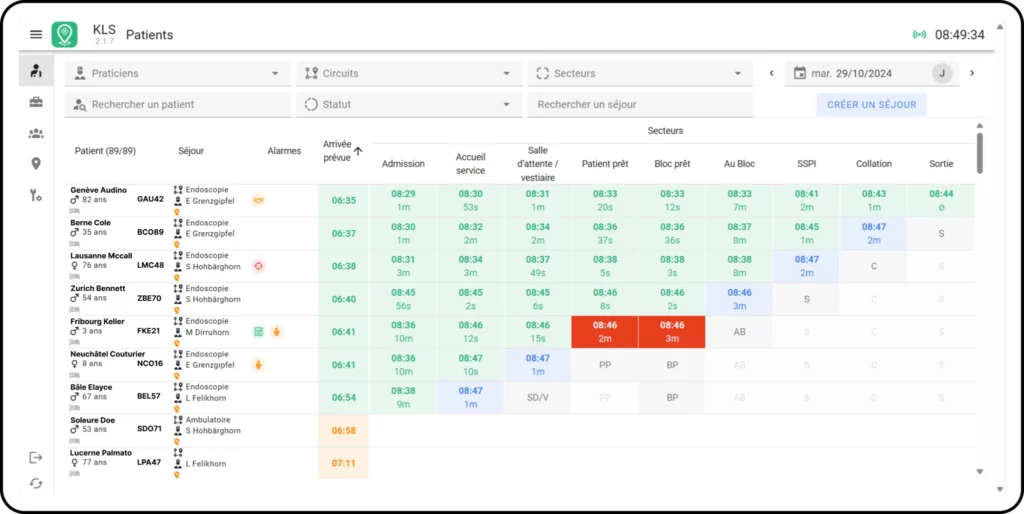
Patient tracking dashboard interface
Patient stay tracking
Tracking patient stays is crucial to optimizing hospital pathways. The software measures the time spent at each stage based on the reason for hospitalization, the practitioner involved, and the care pathway followed.
With this solution, patients can be located at any time, and delays or situations requiring special attention can be identified—improving operational management and quality of care.
Room management
Room management is another essential aspect of optimizing hospital flows. Kheops Location System (KLS) helps identify overloaded rooms that delay procedures, as well as underutilized rooms that could be better used.
The application also ensures that rooms are cleaned and made available as quickly as possible between patients, guaranteeing efficient resource utilization and reduced waiting times.
Smooth internal coordination
Seamless communication between hospital stakeholders is essential for optimal operations. KLS ensures that orderlies are quickly available to transport patients and that medical staff are ready to receive them. This coordination improves responsiveness and quality of care while reducing delays and potential errors. It also significantly reduces inter-team phone calls.
Real-time information for companions
Keeping companions informed in real time is essential for their peace of mind and for optimizing hospital operations. KLS enables relatives to receive updates at every stage of the patient journey, including discharge times—even in case of early or delayed discharge.
By optimizing communication around patient discharges, KLS also helps free up rooms more quickly, improving resource management and reducing waiting times for new patients.
Medical equipment traceability
Medical equipment traceability is critical for effective resource management. The solution allows equipment to be located, tracks items currently in use, and identifies over- or under-equipped departments.
This functionality ensures optimal equipment utilization, reduces costs, and improves availability of resources required for patient care.
Interface and features
Kheops Location System is a web-based application accessible via a modern browser and organized into several modules:
- Patients: Real-time tracking of patient journeys, with alerts for delays or special needs, ensuring optimal patient flow management.
- Equipment: Precise tracking of medical equipment location and usage, enabling efficient resource management and cost reduction.
- Companions: Real-time information for companions, displayed on screens in waiting areas.
- Tags: Inventory management of indoor location tags, facilitating tracking of patients and equipment.
- Statistics: Customized statistics and key performance indicators (KPIs) tailored to the institution’s needs, supporting decision-making.
- Administration: Configuration of workflows, alerts, equipment types, and more to meet specific institutional requirements—ensuring maximum flexibility and adaptability.
Patient and equipment tracking is powered by an indoor location system using Bluetooth Low Energy (BLE) technology. Facilities are divided into zones equipped with beacons that track tags worn by patients or attached to equipment.
The application is flexibly interoperable with other systems—such as EHRs—using standard protocols including HL7, FHIR, and HPRIM.
It complies with current data protection regulations, notably through automatic data anonymization mechanisms.
The future of KLS
Several enhancements are planned for the future of Kheops Location System:
- An application for orderlies, enabling better coordination, reduced transport waiting times, and smoother hospital flows.
- A room cleaning module, designed to optimize cleaning processes between patients, ensuring rapid room availability and improved resource utilization.
- A mobile companion tracking page, allowing relatives to follow patient status in real time via their smartphones, improving communication and accessibility.
- Physical buttons, simplifying interaction with the system and allowing staff to signal key milestones (e.g., room availability or requesting an orderly).
Conclusion
KLS represents a significant and innovative advancement in hospital flow management.
Through its comprehensive features and interoperability with other systems, it optimizes patient pathways, resource utilization, and internal communication.
With the planned future developments, Kheops Technologies will continue to evolve Kheops Location System to meet the specific needs of healthcare institutions—ensuring continuous improvement in quality of care and operational efficiency.