
The challenge of access management in healthcare institutions
Imagine a morning in a hospital. From the very first hours of the day, the environment is already bustling: doctors preparing their rounds, nurses administering treatments, technical teams maintaining equipment, and administrative staff coordinating schedules. All these professionals rely daily on a multitude of applications to perform their work efficiently. But here’s the problem: each system requires a different password to access.
Hospital IT teams spend much of their time managing these passwords and resolving issues related to forgotten credentials. When a user forgets a password or struggles to access a critical system, it leads to delays and frustration—especially in an environment where every second counts for patient care.
Beyond forgotten passwords, security is a major concern. The healthcare sector is one of the most sensitive when it comes to data confidentiality. Access must be strictly controlled to protect patient information and comply with stringent legal requirements, such as GDPR. Yet despite these efforts, security risks persist, particularly due to password reuse and inconsistent access rights management.
The breaking point: too many credentials, too many risks
In the healthcare sector, access management has become a real challenge. Physicians, nurses, and other staff members juggle dozens of passwords to access patient management systems, electronic health records (EHRs), appointment scheduling tools, internal communication platforms, and more. Meanwhile, IT teams lose valuable time resolving access-related issues.
The working environment is already highly stressful, and this additional layer of complexity only worsens the situation. Not only does time lost managing credentials impact productivity, but it also increases the risk of sensitive data being compromised due to weak security practices. This is where Single Sign-On (SSO) comes into play.
Why SSO is the ideal solution for healthcare institutions
Single Sign-On (SSO) allows users to access their healthcare institution’s applications through centralized authentication managed by the organization itself. In other words, with SSO, a healthcare professional needs only one username and password to access all the tools required for daily work—whether it’s the EHR, appointment scheduling software, or medical prescribing systems.
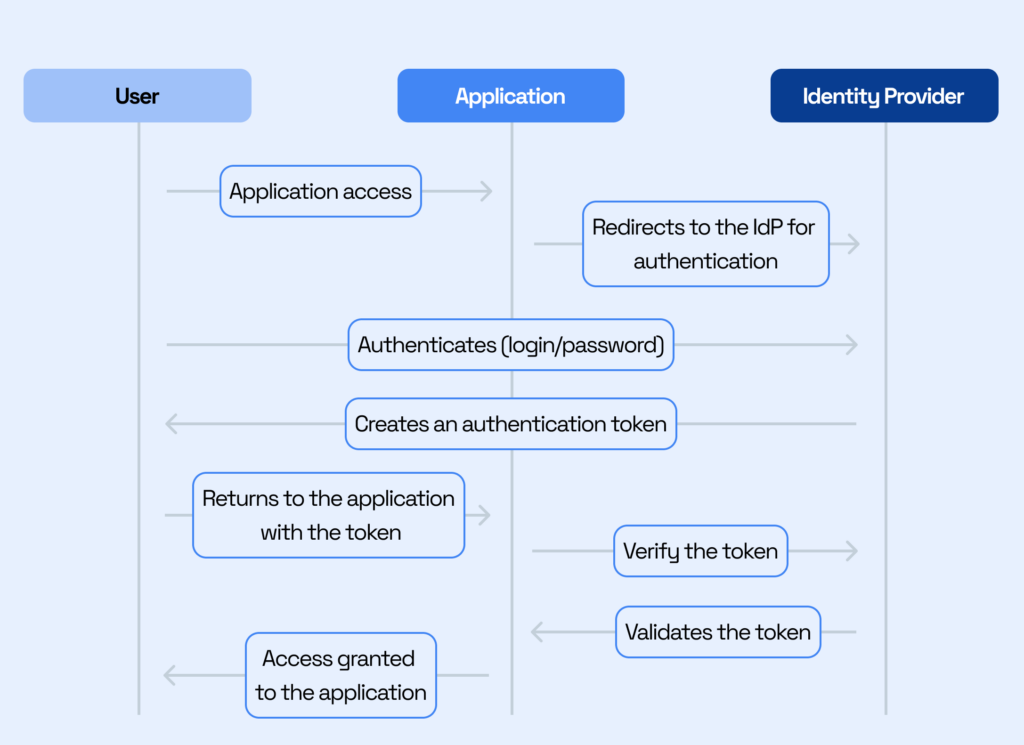
How Single Sign-On (SSO) works
Single Sign-On (SSO) relies on standard authentication protocols such as OAuth 2.0 and OpenID Connect to issue a named access token to various applications.
Each healthcare institution can define global security policies for all applications, as well as application-specific policies. For example, within the internal network, the use of Multi-Factor Authentication (MFA) may be optional, while it can be mandatory when accessing systems from outside the network.
This approach significantly simplifies access management while reducing security risks and improving the user experience.
Addressing healthcare sector challenges
SSO effectively responds to key challenges in healthcare by enabling:
- Secure access and data protection
- Reduced risk of human error
- Simplified access management for IT teams
- Improved user experience for healthcare professionals
- Enhanced compliance and traceability
How does Single Sign-On integrate with ClevEHR?
The electronic patient record solution ClevEHR, developed by Kheops Technologies, supports both local authentication and external authentication via directory services such as LDAP and Active Directory (AD).
Our teams have developed Single Sign-On support to strengthen application security around authentication and to give our clients the ability to define their own security policies for accessing the ClevEHR EHR.
Users no longer need to manually enter their credentials into ClevEHR. In the event of unauthenticated access, they are automatically redirected to their institution’s Identity and Access Management (IAM) system. This redirection is fully transparent if the user is already authenticated through the IAM.
This functionality is also compatible with existing user provisioning within the application. It allows ClevEHR users to be created automatically based on existing users stored in a remote directory.
Single Sign-On: a solution tailored for healthcare institutions
SSO provides an optimized response to access management challenges in the healthcare sector. By enabling secure, single-point access to the multiple applications healthcare professionals rely on daily, Single Sign-On enhances security, operational efficiency, and user experience.
In a critical environment such as healthcare—where every decision can have an immediate impact on patient lives—simplicity, speed, and security are essential.
Healthcare institutions that adopt SSO free their teams from repetitive administrative tasks and allow healthcare professionals to focus on what truly matters: their patients.