Beyond the engineering and technical challenges involved in developing IT solutions, a software publisher’s primary role is to address business needs and user needs.
The true added value of an IT solution lies above all in its ability to respond to the daily challenges faced by its users in the specific context of their profession. This represents a real challenge given the diversity, complexity, and volume of information that a medical information system must manage and secure.
What is a Design System ?
A Design System is a software development approach based on a library of graphical components, including elements such as fonts, colors, and images that are ready to use. This library provides consistent, reusable elements for building user interfaces.
With this approach, designers can create coherent, user experience–focused mockups, while developers can build on existing work and enhance the user experience by reusing optimized core components.
By using a Design System, we ensure visual and functional consistency across our products, while also improving the efficiency and productivity of our development teams.
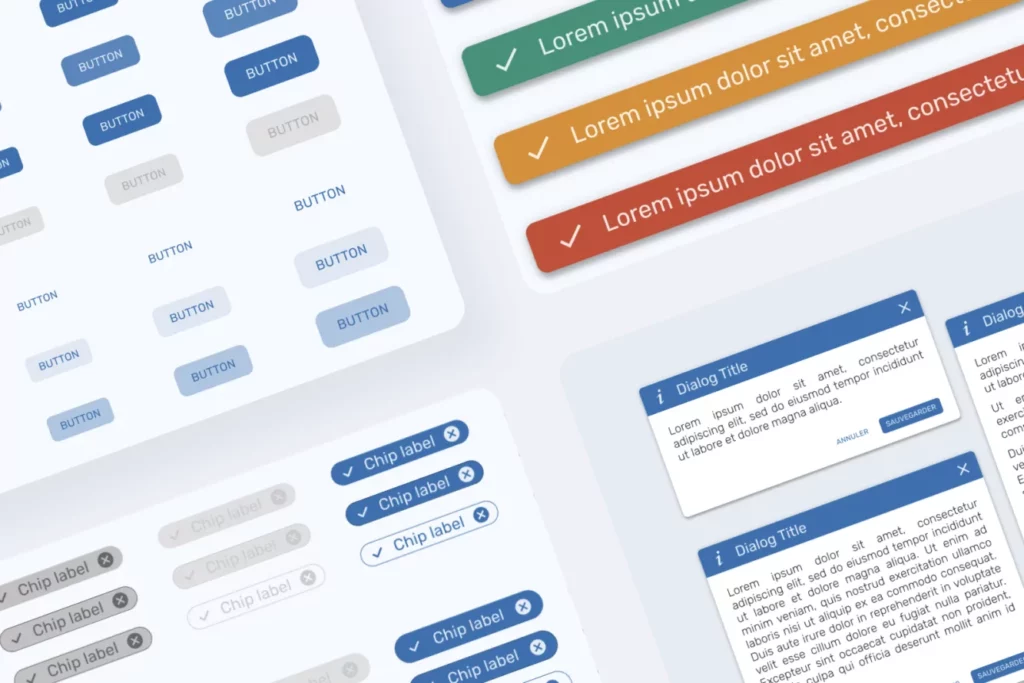
Design System Components
User Centered Design
User-Centered Design (UCD) is a development approach that has gained significant popularity in recent years due to its proven effectiveness. By adopting a methodology focused on User Interface (UI) and User Experience (UX), this approach aims to create solutions that are ergonomic, clear, and easy to use, while maximizing efficiency.
User-Centered Design is built on several key principles:
- Understanding users’ business needs, their environment, and constraints,
- Involving users from the very early stages of the design process,
- Having users evaluate different prototypes in order to refine and improve them,
- An iterative and multidisciplinary process, in which analysts, specialists, users, and developers all contribute their expertise.
The benefits of a Design System
Adopting a Design System offers numerous benefits for companies like Kheops, especially in the healthcare sector:
- Consistent user interfaces,
- Each element or concept can be reused or improved (both functionally and technically),
- A scalable and reusable component library,
- Particularly well suited to an Agile development approach,
- Easier and more systematic maintenance,
- A strong and consistent visual and UX identity for the target solution.
In addition, a Design System facilitates communication between all project stakeholders by establishing a shared language, thereby reducing the risk of misunderstandings or misinterpretation.
The benefits of a Design System
Adopting a Design System offers numerous advantages for companies like Kheops, particularly in the healthcare sector:
- Consistent user interfaces,
- Each element or concept can be reused or enhanced (both functionally and technically),
- A scalable and reusable component library,
- Especially well suited to an Agile development approach,
- Simpler and more systematic maintenance,
- A strong and consistent visual and UX identity for the target solution.
In addition, a Design System facilitates communication between all project stakeholders by establishing a shared language, thereby reducing the risk of misunderstandings and misinterpretations.
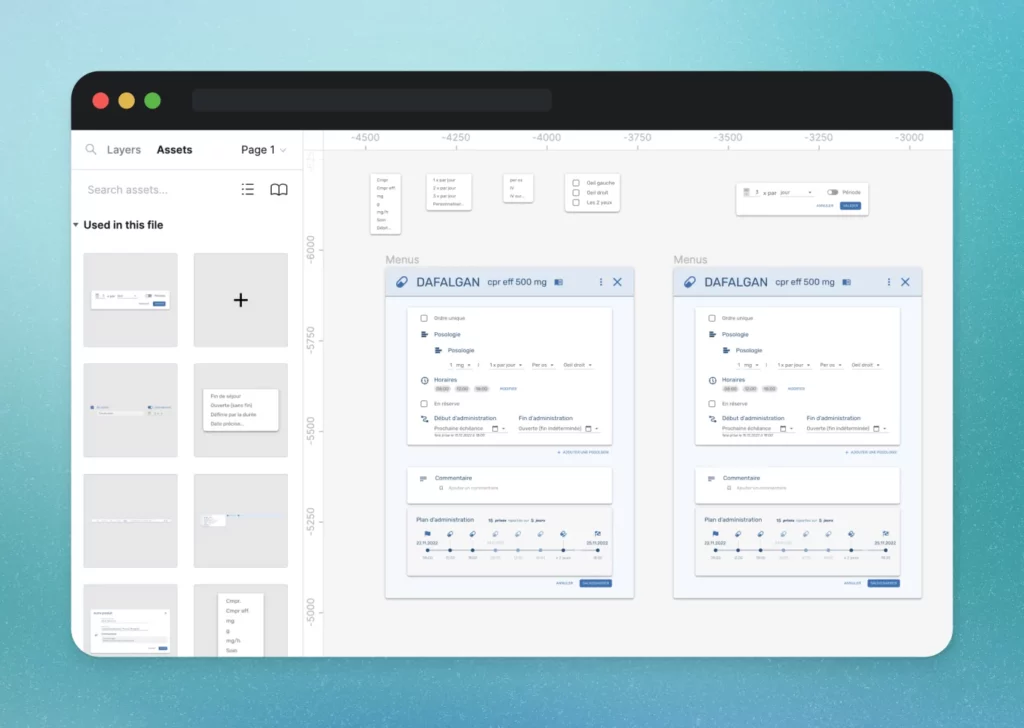
Using the Design System for ClevEHR Prescriptions
Challenges related to the Design System
Despite its many advantages, adopting a Design System can present challenges for an organization. User habits, in particular, can shape how screens are perceived, making change difficult to implement. In addition, a Design System must align with current design trends while also meeting the specific regulatory and usability requirements of the healthcare sector.
However, these challenges can be overcome through a methodical approach and close collaboration between designers, developers, and end users.
Ultimately, adopting a Design System is a crucial step in the development of medical software, ensuring a user-friendly, rigorous, and clear interface, along with a visual representation that is fully adapted to the needs of the healthcare industry.