
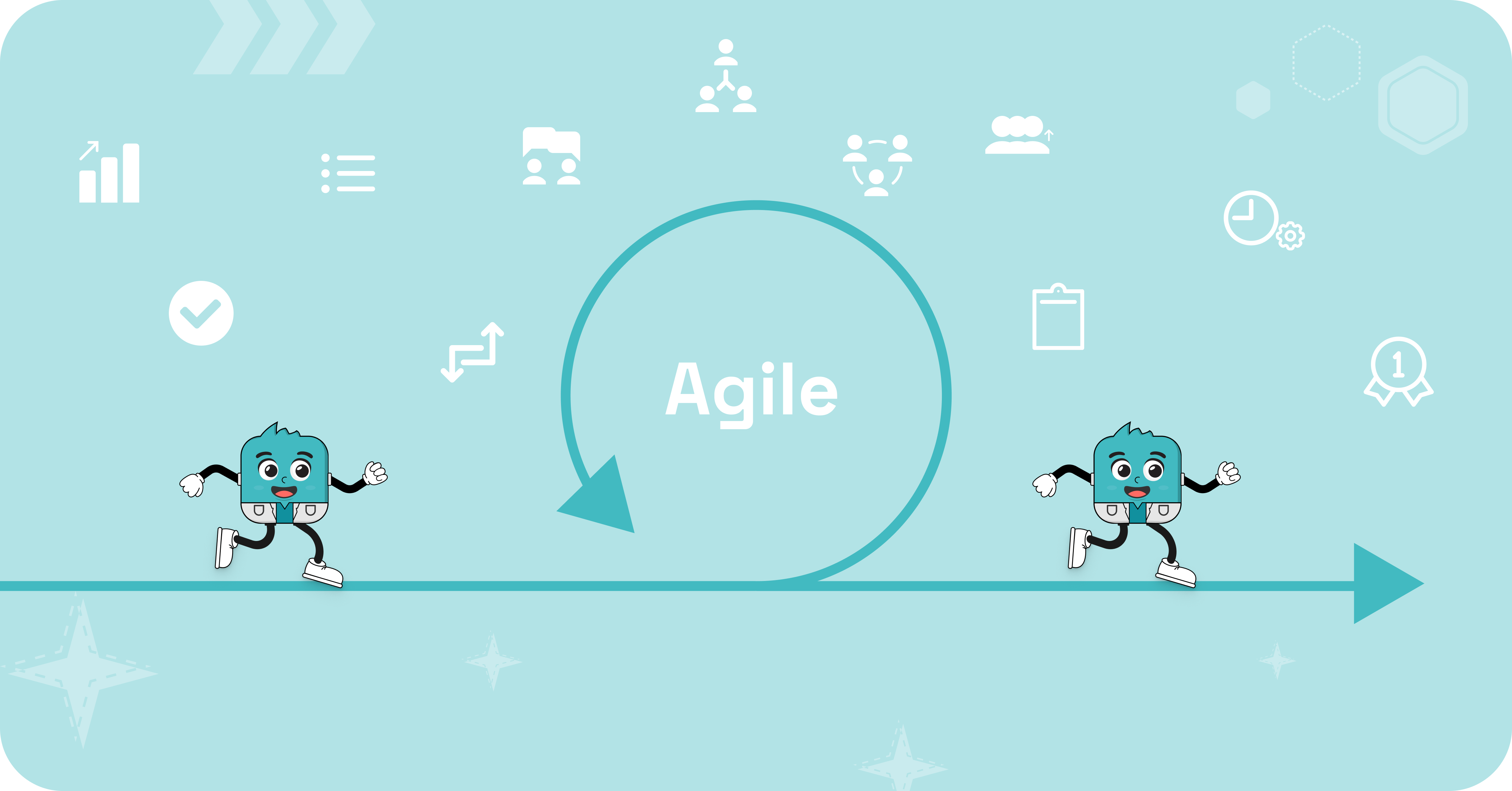
In a constantly evolving professional environment, the agile approach has established itself as a framework for project management. Originally emerging from the software development sector, this approach is now adopted across a wide range of industries. Thanks to its flexibility, its ability to adapt quickly to change, and its focus on continuous improvement. But what does this actually mean for the teams and organizations that use it?
What is the agile approach?
This approach is not a rigid methodology, but rather a set of principles and values outlined in the Agile Manifesto, published in 2001. This manifesto emphasizes four core values:
Individuals and interactions
Prioritizes collaboration and human interaction, as success depends more on teams than on tools.
Working software
Focuses on delivering usable features quickly, emphasizing direct user experience.
Customer collaboration
Encourages continuous co-creation with the customer to address real needs.
Responding to change
Adapts the product based on feedback and evolving requirements, making outcomes more relevant and flexible.
These values form the philosophical foundation of agile practices and help guide decision-making toward more flexible, collaborative, and customer-focused development.
The agile approach is based on short iterations (called sprints), during which a functional part of the product is developed, tested, and delivered. Unlike traditional project management methods that follow a fixed plan, agile allows priorities to be adjusted based on customer feedback or changes in context.
The fundamental principles of agility and their implementation at Kheops
It is based on a set of principles from the Agile Manifesto (agile approach):
Customer satisfaction
Deliver early and continuously to maximize value.
At Kheops: We deliver several major releases each year and multiple minor releases every month. Development and testing cycles are kept as short as possible to encourage close interaction with our customers. Given the size and complexity of software such as ClevEHR, this represents a significant challenge. Development phases are organized into 15-day sprints, each sprint forming a logical grouping of enhancement requests.
Adaptability
Welcome and integrate change, even late in the process, to meet evolving needs.
At Kheops: Short release cycles and 15-day sprints allow us to review and adjust our planning very frequently.
Frequent delivery
Release functionality in small increments to reduce risk.
At Kheops: Even major enhancements are broken down into functional batches that can be tested as early as possible. These intermediate deliveries reduce risks and avoid “tunnel effects” or big-bang releases.
Continuous collaboration
Maintain close communication between teams and stakeholders.
At Kheops: We actively involve our customers in major evolutions—such as this year’s redesign of ClevEHR prescription management—or in the development of new KLS features. Our internal organization relies on integrated “business” responsibilities at every stage of development (analysis, development, testing, documentation).
Team motivation
Create a supportive environment and encourage autonomy.
At Kheops: Our objective is to guide employees toward greater autonomy and interdependence within and across teams. In practice, technical leads do not assign tasks directly but propose work packages (sprints), allowing team members to self-organize and take ownership of the workload. This is one of many examples of our empowering—and therefore motivating—work environment.
Preference for direct communication
Encourage face-to-face discussions to avoid misunderstandings.
At Kheops: This is one of the objectives of our daily rituals, known as “Scrums”: short 10- to 15-minute team meetings to discuss the day’s priorities and schedule any necessary follow-up discussions.
Progress measured by working features
Evaluate projects based on delivered functionality.
At Kheops: Our products are structured into modules, further divided into features described through usage scenarios. These scenarios become test cases used to validate development work. The creation of test cases also forms the foundation of user documentation. Product evolution occurs through minor versions (functional enhancements) and major versions (new modules).
Sustainable pace
Maintain a balanced work rhythm and avoid overload.
At Kheops: We place great importance on allowing employees to define their working time (part-time or full-time), remote work days, and adapting the work environment to personal constraints whenever possible.
Technical excellence
High-quality practices ensure flexible and maintainable products.
At Kheops: We are proud to have teams that combine high technical expertise, a strong service mindset, and deep domain knowledge. In the healthcare sector, this is essential—and a pleasure to witness every day.
Simplicity
Avoid unnecessary complexity and focus on what truly matters.
At Kheops: Proposed evolutions are assessed against several criteria, with complexity being the most decisive factor when trade-offs are required.
Self-organizing teams
Encourage autonomy to foster creativity and ownership.
At Kheops: Our goal is precisely to develop interdependence between individuals and between teams.
Continuous improvement
Adapt practices to enhance efficiency and quality over time.
At Kheops: We use several collaboration tools integrated into a highly efficient production pipeline that supports tracking, continuous improvement, and performance measurement.
It is a preferred approach for complex and evolving software production environments.
Common methods and practices in the agile approach
Scrum:
An agile methodology structured around sprints (short development cycles) and clearly defined roles (Scrum Master, Product Owner).
Kanban:
This method relies on limiting Work In Progress (WIP), a concept that closely resembles sprint-based workflows. Kanban is often seen as a lighter version of Scrum and aims to improve team flexibility and efficiency.
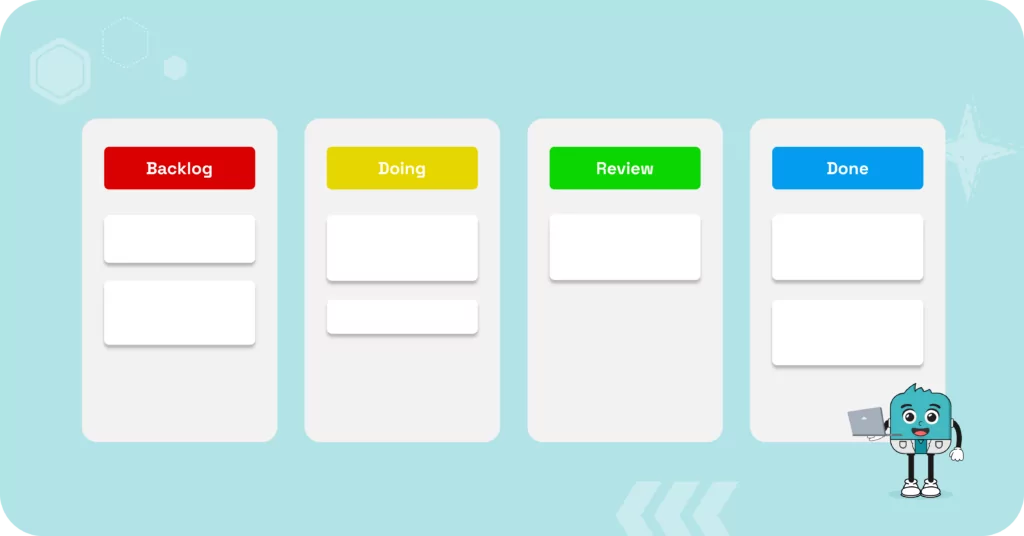
Example of a workflow management diagram
Extreme Programming (XP)
Extreme Programming (XP) is focused on test-driven development, pair programming, and refactoring. This method places strong emphasis on technical best practices.
Benefits of the agile approach
- Flexibility and adaptability
- Rapid delivery of value
- Continuous product improvement
- Risk reduction
- Increased customer satisfaction
- Transparency and improved communication
- Motivated and autonomous teams
- Improved product quality
- Sustainable work pace
- Better priority management
Agile: a response to the challenges of the modern world
The agile approach has established itself as an essential working framework across many industries, thanks to its ability to adapt to changing needs, involve customers in the creation process, and promote continuous improvement. For teams seeking to increase responsiveness, improve delivery quality, and work more collaboratively, agile represents a particularly effective response to the challenges of today’s world.
Adopting Agile means equipping organizations with the ability to evolve smoothly in an uncertain and constantly changing environment.