

The integration of healthcare systems has become a critical challenge in improving quality of care, service efficiency, and patient satisfaction. APIs (Application Programming Interfaces) play a central role in facilitating communication and interoperability between different systems and applications.
What is an API?
An API (Application Programming Interface) is a set of rules and protocols that enables communication with an application, a data service, or software components. It acts as an interface through which a software application exposes structured services to third-party systems.
What are the benefits of APIs in healthcare systems?
Interoperability and automation
APIs enable various systems (electronic health records, hospital management systems, telemedicine applications) to share information seamlessly and automate repetitive manual processes, thereby improving care coordination.
Real-time data exchange
They allow real-time data exchanges, which are essential for fast and informed decision-making.
Reduced development time
APIs simplify data integration development between software systems. They establish data exchange “contracts” through their structured design, making development faster, more reliable, and easier to test—thus accelerating service integration across systems.
Scalability
APIs facilitate the seamless integration of new services, ensuring scalability in line with evolving needs and the functionalities available on the market.
Examples of API usage
APIs make it possible to establish connections between information systems more quickly. For example, offering APIs to other systems is particularly beneficial for electronic health record management systems. Data exchanges are easier to implement and therefore less costly. With the same amount of development effort, it becomes possible to multiply data flows, fostering information sharing and, ultimately, improving the quality of care.
These data exchanges take place machine to machine, without intermediaries. The data is highly secure and remains within encrypted channels. It passes through very few intermediate systems and is therefore better protected than many other forms of data exchange. By comparison, it is more secure than exchanges via email or messaging applications such as WhatsApp.
Data exchange between healthcare systems is inherently complex. APIs are highly structured and conceal part of the complexity of the underlying software. They define a precise language, often leaving no room for interpretation. As a result, the risk of errors during data exchange is reduced, the level of control is higher, and the need for deep medical-domain expertise within development teams is lower.
What are the challenges and future developments of APIs in the healthcare sector?
Artificial intelligence
Most AI solutions are accessible via APIs. Enabling the integration of healthcare software with AI technologies could lead to significant advances in predictive analytics and personalized medicine. Concrete examples include support in establishing diagnoses, accelerating clinical note-taking, medical image analysis, and more.
Interoperability
Improved interoperability would facilitate data exchange between different systems and stakeholders across the healthcare sector, thereby enhancing care coordination and operational efficiency.
How APIs are transforming Kheops solutions and enhancing your healthcare institution
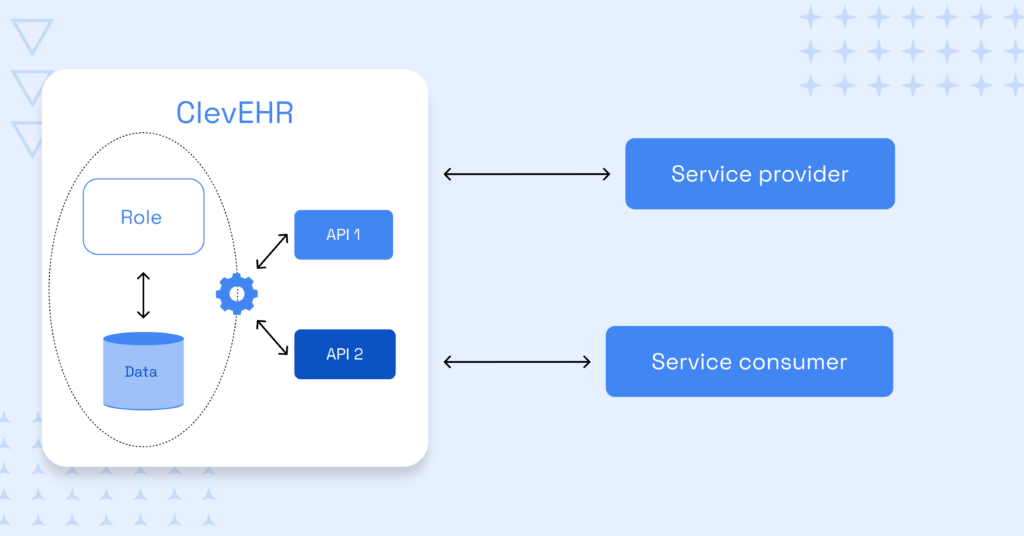
Enhancing and accelerating the development of software solution features
APIs enable data to be exposed in a consistent and standardized manner.
Regardless of the type of data our solutions interact with, they use a standardized method to query the server and structure responses. This means that data can be read or written in multiple areas of the application without requiring code changes. This approach simplifies both software development and maintenance.
In summary, APIs are powerful tools that enable healthcare systems to communicate and work together more efficiently. They simplify software development and support uniform, secure data management.
By adopting solutions that leverage Application Programming Interfaces (APIs), healthcare institutions can improve the quality of care and the efficiency of their services, creating a more connected and high-performing healthcare environment.